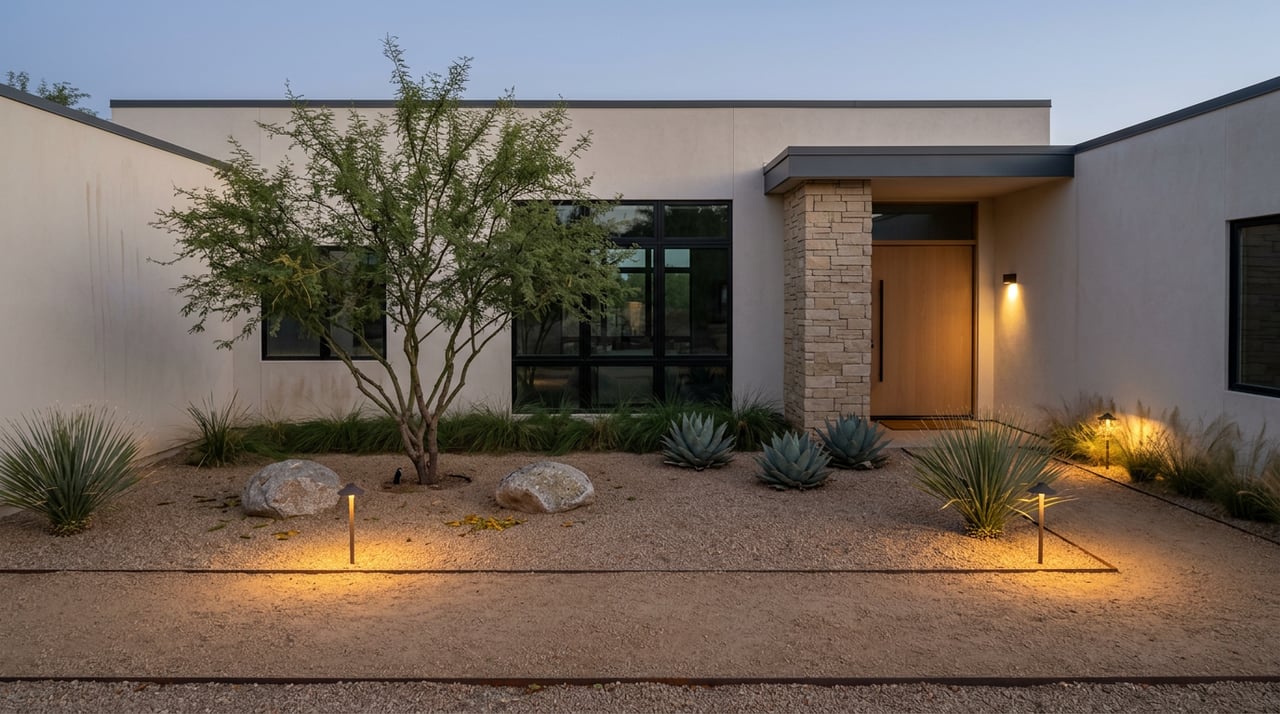
Scottsdale Hasn't Declared What the Internet Says It Has
September 17, 2026
September 17, 2026
If you searched for Scottsdale watering restrictions this month, you probably found a page telling you the city moved to mandatory two-day-a-week irrigation, the same emergency footing as Phoenix, Mesa, Chandler, Gilbert, and Tempe. Assigned watering days by street address. Warnings, then fines. A citywide overseeding ban.
None of that describes what's actually happening on your street.
Scottsdale is still in Stage One of its own Drought Management Plan, the voluntary tier, the one built around monitoring and encouragement rather than enforcement. There is no assigned watering day. There is no fine schedule waiting for a second offense. The city's own water pages state it plainly: there are currently no mandatory water-use restrictions on Scottsdale residents or businesses as a result of the ongoing Colorado River shortage.
That gap between what generic watering-schedule sites are telling you and what the city is actually doing isn't a rounding error. It's the story.
Arizona's shortage framework runs on two tracks that get flattened into one headline everywhere else online. There's the federal Colorado River tier, set by the Bureau of Reclamation based on Lake Mead's elevation, and there's each city's own internal drought stage, which can move independently of the federal declaration. For 2026, the Colorado River is operating under a Tier 1 Shortage. Scottsdale's own plan, separately, sits at Stage One.
Stage One means increased monitoring, conservation outreach, and a request that residents and the city itself trim usage voluntarily. It does not mean:
Those are Stage Two features, the tier some sites are describing as if it were already active here. Scottsdale hasn't gone there. In a July 2026 interview with Arizona's Family, the city's assistant senior director for water resources, Bryan Cassens, put it directly.
"The City of Scottsdale is currently not doing water restrictions because we are in a position now where we don't need to."
That's not a hedge. It's a city telling you, on the record, that the tighter framework circulating online doesn't apply here yet.
The reason Scottsdale hasn't needed to move stages isn't luck. It's a specific set of purchases and infrastructure decisions the city has been making for years, and the most recent one happened this summer.
In July 2026, the Scottsdale City Council approved spending $8.25 million on water from the Harquahala Valley, a designated groundwater basin west of Phoenix, purchased through the Vidler Water Company. Scottsdale draws roughly 70 percent of its water from the Colorado River, a heavier share than Phoenix, which sits closer to 40 percent. That dependence is exactly why the city has spent the past several years diversifying rather than waiting for a shortage to force the issue.
The Harquahala purchase adds acre-feet the city can draw on without touching its Colorado River allocation. It's a hedge, not a solution, and city officials have been candid that the harder question isn't the water itself but the plumbing. Getting water from a west-valley basin to homes in far north Scottsdale means running it through the right treatment plant and the right pipes, and that infrastructure question is still being worked out even as the purchase moves forward.
The other piece of the diversification story is less visible because it's underground. Scottsdale's Advanced Water Treatment Plant, part of the Scottsdale Water Campus in north Scottsdale, takes highly purified recycled water and injects it back into the aquifer, where it filters through roughly 400 feet of natural rock before it's available again as drinking water. The city recharges more than 1.7 billion gallons of purified recycled water into that aquifer every year.
The city is also building four new Aquifer Storage and Recovery wells at strategic points around Scottsdale, designed to bank water during low-demand months, typically late fall and winter, and hold it in reserve for peak summer demand or an actual supply emergency. Combined with long-term storage credits the city has been accumulating for years, this is the layered portfolio that's let Scottsdale stay a step behind the more aggressive restrictions some neighboring cities have had to consider.
Scottsdale was also the first city in Arizona to declare even Stage One of its drought plan, back in 2022, well ahead of any federal mandate. The pattern here isn't reactive. It's a city that moves early on monitoring and conservation messaging specifically so it doesn't have to move fast on mandatory rationing later.
None of that means Stage One is permanent. The framework that's kept Arizona's Colorado River allocation at Tier 1 for 2026 expires at the end of this year. The Bureau of Reclamation released its final environmental impact statement for post-2026 river operations in July 2026, and the new operating guidelines, covering how Lake Powell and Lake Mead get managed starting in 2027, are still being finalized. Lake Mead remains at historically low levels even under Tier 1, and if it drops far enough to trigger a Tier 2 or Tier 3 federal shortage, Scottsdale's own plan would likely need to respond in kind.
The city's plan is built to scale with that risk. If deliveries to treatment plants get reduced or curtailed, the drought plan has room to move to Stage Two, which is where the shortage surcharges, mandatory restrictions, and enforcement schedule other Arizona cities are already living with would actually apply here. City leadership has been transparent that this is a multi-year situation, not a single-season scare, since water supplies are forecast to hold steady at best going forward, not grow.
So the honest version of this story isn't "Scottsdale is immune." It's that Scottsdale bought itself time, specifically, through named purchases and named infrastructure, and that time is finite and tied to decisions still being negotiated at the federal level through the rest of this year.
If you live here, the practical takeaway is simple. You are not required to water on a specific day. You are not restricted to a two-day schedule. Your HOA doesn't have a state statute to lean on to fine you for a green lawn, because there's no declared shortage triggering that protection in the first place, since none applies. If a service, a site, or a neighbor tells you otherwise, ask them for the source, because the city's own pages say the opposite as of this writing.
That said, conservation outreach here isn't nothing. The city is still asking residents to use water wisely outdoors, since that's where a significant share of Scottsdale's municipal water use happens, and the rebate programs for turf conversion and irrigation upgrades exist independent of whatever stage the city is in. Taking advantage of those now, while there's no enforcement pressure attached, is a different decision than being forced into it later under a Stage Two order.
Keep an eye on the Bureau of Reclamation's post-2026 guidelines as they finalize over the coming months. That's the lever that matters more than anything a watering-schedule aggregator publishes. And if you want the fuller picture of how water planning fits into the broader conversation around new construction, lot values, and long-term ownership in Scottsdale, that's a conversation worth having directly rather than piecing together from sites that don't know the difference between a federal tier and a city stage.
If you're weighing a move within Scottsdale, evaluating a lot, or just want a clearer read on how the city's water picture might shape decisions down the road, Rami Haddad is glad to walk through it with you. Let's Connect.
Stay up to date on the latest real estate trends.


From pricing and marketing to negotiation and closing, Rami delivers a customized plan designed to maximize results and minimize stress.