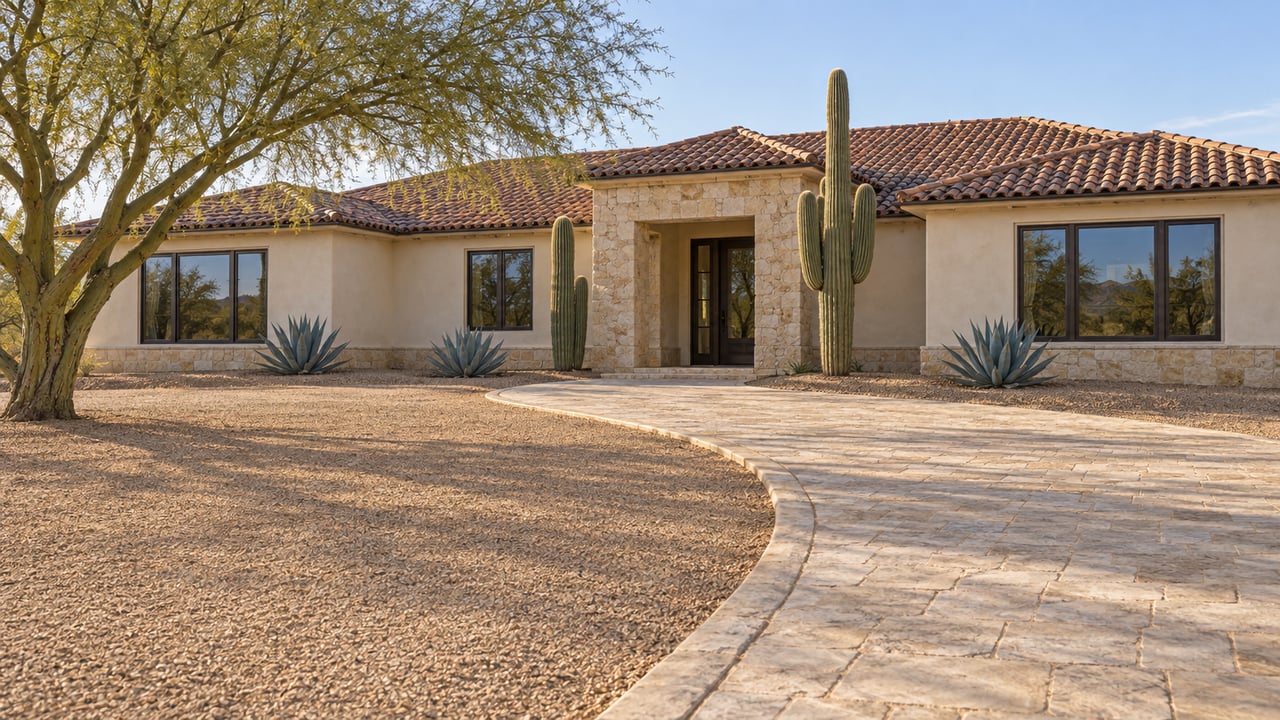
Why Tearing Down an Older Paradise Valley House Can Shrink the Lot Underneath It
October 1, 2026
October 1, 2026
A buyer who puts a contract on a 1970s ranch house on four-plus acres in Paradise Valley usually has one plan: clear the lot, build something current, and let the land do the rest of the work on resale. In most of the Valley that plan holds up. In Paradise Valley's largest residential zoning district, it can backfire before the first truck arrives.
On certain R-175 parcels, the Town's zoning code ties the buildable envelope to a specific date. If a qualifying primary structure existed on the lot before June 13, 1991, the front setback can be as tight as 40 feet. Remove that structure, or never have one there to begin with, and the same parcel can face a 100-foot front setback instead. That is a 60-foot swing in how far back a new house has to sit from the street, on a zoning tier where lots already run over four acres and floor area is capped near 25 percent regardless of budget. Buyers who assume a teardown is pure upside are often pricing the lot on a footprint they no longer have the right to build on.
The mechanism is not a penalty. It reads more like a preservation clause. R-175 is Paradise Valley's largest-lot single-family district, built around the idea of low-density, deep-set homes on four-plus acres. A structure that predates June 13, 1991 gets to keep the siting pattern it was originally built under, including a 40-foot front setback that lets the house sit closer to the road than current standards would otherwise allow. Take that structure down and the parcel reverts to the modern standard, which on these lots pushes the front setback out to 100 feet.
For a buyer underwriting a deal, that distinction changes the site plan before an architect ever opens a drawing program. A 100-foot setback does not just move the house back. On an irregular or view-driven lot, it can eat into the buildable pad enough to force compromises on garage placement, motor court size, or how the home relates to a mountain view that was the reason for the purchase in the first place.
This is not only a demolition problem. Paradise Valley treats a nonconforming structure's protected status as something that can be lost in pieces, not just all at once. If a renovation or addition affects more than half of the roof area or exterior wall area on a nonconforming portion of a home, that portion may be required to meet current setback rules going forward. A buyer planning an extensive addition rather than a full teardown can trigger the same loss of grandfathered siting if the scope of work crosses that threshold.
The Town's demolition permit rule sharpens the point further. A demolition permit is required once more than 12 linear feet of wall or fence, or 12 square feet of roof structure, comes down, and that permit has to be pulled before the building permit. Twelve linear feet is not a bulldozer decision. It is closer to what a contractor might remove while opening up a single wall for a great room addition. The practical result is that both full rebuilds and ambitious remodels need a zoning read before design work begins, not after.
| R-43 | R-175 | |
|---|---|---|
| Minimum lot size | 43,560 sq ft (1 acre) | 175,000 sq ft (4+ acres) |
| Front setback, standard | 40 ft | 40 ft (100 ft if no qualifying pre-1991 structure remains) |
| Side setback | 20 ft (40 ft for two-story or over 24 ft) | 40 ft |
| Floor area ratio | 25% | 25% |
The two districts look similar on paper until the pre-1991 clause is factored in. R-43 lots do not carry the same setback swing, which means the risk concentrates specifically in Paradise Valley's largest-lot neighborhoods, the ones marketed hardest as teardown-and-rebuild opportunities.
Setbacks are only half of what caps a rebuild. Paradise Valley's height limits step up with lot size: 24 feet for lots under three acres, 26 feet for lots between three and four acres, and 30 feet for lots four acres and larger. On non-hillside R-43 and R-175 parcels, an additional Open Space Criteria rule applies. Per the Town's own height certification guidance, no part of the building can penetrate an imaginary plane that begins 16 feet above the 20-foot setback line and rises toward the center of the lot at a 20 percent slope. Combined with a lost setback allowance, a buyer can end up with a smaller buildable pad, a lower height ceiling relative to that pad, and less flexibility on massing than the acreage on the listing sheet suggested.
Paradise Valley's own 2022 General Plan noted that only about 5.2 percent of the planning area remained undeveloped, meaning most of what gets marketed as new construction here is really a teardown of something older, not a build on raw land. That scarcity is pushing prices up at both ends. Per-square-foot values in the 85253 zip code reached $987 in May 2026, up from $951 in April, and the median sale price sat near $5.2 million that same month, with active listings carrying a median list price above $5.25 million as of June 2026.
Genuine vacant infill has become rare enough that it commands its own premium. Silver Sky, a 12-lot enclave at the base of Mummy Mountain that reached formal plat approval in 2023, sidesteps the setback puzzle entirely because it started from a clean plat rather than an older lot. The community's Nova estate, an 11,832-square-foot Modern European home developed by Silver Sky Development, sold for $20 million while still under construction, according to reporting on the deal. That kind of pricing on a project with no teardown history at all underscores how much of a premium clean, unencumbered land now carries relative to a parcel that comes with a pre-1991 structure and a setback decision attached.
Current listing activity shows teardown interest concentrated in older, larger-lot enclaves including Clearwater Hills, Sunset Hills, Chaparral Estates, Braecrest, Franciscan Terrace, and Sunburst Farms Hallcraft. These are exactly the neighborhoods where a home's actual construction date, not just its zoning district, becomes the variable that decides whether a demolition helps or hurts the deal.
The capital chasing these plays is real. A record-setting $40.2 million sale on Mockingbird Lane, a 20,900-square-foot estate designed by Candelaria Design and built by Arcadia Custom Builders on speculation, closed as an all-cash deal and became the most expensive home sale in Arizona history. Norton Luxury Homes and Stately Development closed a $16 million spec sale on an 8,331-square-foot home near Mummy Mountain and are moving forward with five more projects, three of which are slated to list above $25 million. And a 4.75-acre lot with a nine-bedroom home built in 1952 sold for $14.3 million in cash, priced entirely as a land play with the existing structure expected to come down, according to the listing agent who handled the sale.
That last example is the clearest illustration of the risk. A deal underwritten purely on land value depends on knowing what can legally be built on that land once the existing structure is gone. If the home being razed happens to be the thing keeping a 100-foot setback at bay, the underwriting needs to account for that before the price is set, not after the permits come back.
Zoning district and construction date are both public record, and both should be confirmed before a Paradise Valley teardown gets priced as a straightforward upgrade. That means pulling the parcel's zoning designation, checking the recorded construction date through county assessor records, and getting a pre-application read from the Town's Planning Division on setback and height before finalizing an offer. A land appraisal on a teardown lot is only as reliable as the site plan it assumes, and on R-175 parcels with a pre-1991 structure, that assumption is worth verifying line by line.
If you are weighing a teardown, a major addition, or a lot purchase in Paradise Valley and want a second set of eyes on the zoning math before you commit capital, Rami Haddad works through these site-specific questions with buyers and investors before the offer stage, not after. Reach out through the developments page to start that conversation.
Stay up to date on the latest real estate trends.


From pricing and marketing to negotiation and closing, Rami delivers a customized plan designed to maximize results and minimize stress.