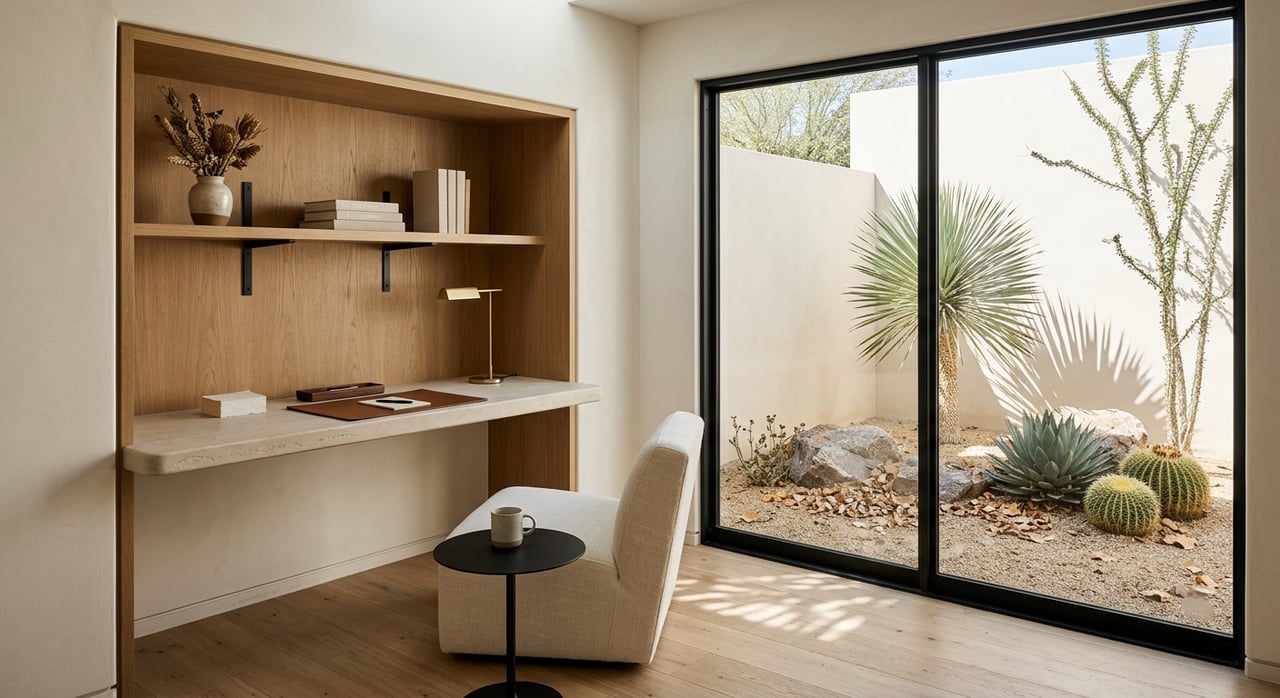
Phoenix Investment Property Guide for Long-Term Buyers
June 4, 2026
June 4, 2026
If you are looking at Phoenix homes as long-term investments, the big question is simple: are you buying into real value or just chasing an old boom story? That is a fair concern, especially in a market that has cooled from its faster-growth phase. The good news is that Phoenix still has several fundamentals that matter over time, and this guide will help you look at them with a clear, practical lens. Let’s dive in.
Phoenix remains one of the largest and fastest-growing markets in the country. The city’s 2025 population estimate reached 1,665,481, while Maricopa County grew to 4,689,558, up 6.0% from 2020. That kind of growth does not guarantee appreciation, but it does help support long-run housing demand.
The local economy also adds depth to the investment story. The Phoenix metro reported 4.0% unemployment in March 2026, and total nonfarm employment reached 2.492 million in April 2026. Job gains in education and health services and in professional and business services matter because a broad employment base tends to create more stable housing demand over time.
Phoenix also benefits from major employment hubs and business investment. The City of Phoenix says Sky Harbor supports more than 47,000 jobs across the metro, and Arizona Commerce Authority reported 24,285 projected new Arizona jobs and more than $31 billion in capital investment in FY25. For a long-term buyer, that supports the idea that Phoenix is more than a short-cycle market.
If you are evaluating Phoenix as an investment, it helps to be realistic about where the market stands today. Recent data points show a market that is cooler and more selective than it was during the rapid-growth years. That is not necessarily bad for a long-term buyer, but it does change how you should analyze deals.
Zillow reported the average Phoenix home value at $411,323 as of April 30, 2026, down 2.4% year over year. It also showed about 5,617 homes for sale, with homes going pending in roughly 23 days. Redfin reported a median sale price of $460,637 for the three months ending April 2026, down 0.94% year over year, with homes taking about 53 days to sell.
These figures are not identical, but they point in the same direction. Phoenix is not in a rapid-boom phase right now. That means your investment case should rely less on short-term price spikes and more on a multi-year view built around demand, holding power, and smart property selection.
In Phoenix, appreciation is often driven by a few core forces: population growth, job growth, and scarcity at the neighborhood level. Those are stronger long-term drivers than broad market hype. When you buy with a longer horizon, those fundamentals matter more than whether one calendar year is slightly up or down.
It is also important to remember that supply is still part of the equation. Maricopa County recorded 31,651 building permits in 2025, which shows that new housing supply remains meaningful. In other words, not every home will benefit equally, and location, product type, and resale appeal still matter.
That is why a blanket statement like “all Phoenix homes are great investments” falls apart under real analysis. Some homes will have stronger long-term upside because they better match local demand and have more durable resale appeal. Others may look attractive on paper but struggle with weak rent performance, higher carrying costs, or slower resale.
A long-term investment should always be tested with actual rent math. Phoenix has a substantial rental base, and the city’s owner-occupied housing rate is 57.3%, which implies a sizable renter population. Census data also shows a median gross rent of $1,582, while Zillow’s April 2026 rental figure for Phoenix was $1,571, which is very close.
That consistency is useful because it gives you a reasonable starting point when screening opportunities. Using Census medians, Phoenix’s rough gross rent-to-value ratio is about 4.5% before vacancy, maintenance, taxes, insurance, HOA dues, and financing costs. This is not a true cap rate, but it can help you quickly spot homes that may deserve deeper review.
The key point is that cash flow can vary a lot from one property to another. A home with stronger rent potential, lower carrying costs, and better long-term appeal may make much more sense than a similar home with weaker numbers. As an investor, you want to underwrite the exact property, not the city in general.
One of the biggest mistakes buyers make is focusing too much on purchase price and rent while treating operating costs like an afterthought. In Phoenix, desert living comes with some local cost considerations that should be built into your numbers from day one. That is especially true if you are planning to hold the property for years.
Water is one of those factors. The City of Phoenix says water rates include a fixed service charge, volume charges, and environmental charges. The city also emphasizes conservation and reliability during Colorado River shortages, which means irrigation choices, landscaping design, and water usage can directly affect your operating costs.
Property taxes also deserve close attention. Maricopa County says taxes are determined by dividing assessed value by 100 and multiplying by the tax rate set in August, with bills issued in September. The Treasurer says the first half is due October 1 and the second half is due March 1, with delinquency after May 1.
These are not small details. Over a long holding period, taxes, insurance, utilities, HOA dues, and maintenance can shape your returns just as much as the purchase price. Strong underwriting means looking at the full ownership picture.
In a softer or mixed market, time becomes even more important. If prices are flat or slightly down year over year, your margin for error gets smaller if your plan depends on a quick resale. That is why Phoenix looks more convincing as a long-term hold than as a short flip-style thesis right now.
Current signals support that view. Inventory is available, price trends are mixed to slightly softer, and the sale-to-list environment is less aggressive than in the boom period. For many buyers, that means patience is part of the strategy.
A longer holding period gives you more time to ride out market fluctuations, benefit from broader metro growth, and potentially improve returns through better rent positioning or property upgrades. It also gives you more room to make a thoughtful purchase instead of forcing a deal based on short-term momentum. In this market, patience is not passive. It is part of the investment case.
Before you buy, focus on practical questions that help you understand the real risk and upside of a specific property. These questions keep your analysis grounded and help you avoid buying based on general market optimism.
Can this exact home command rent that supports your goals? Market-wide rent figures are a helpful starting point, but they are not enough. The property’s layout, condition, location, and operating costs all affect what the numbers look like in real life.
How stable is the job base around the area you are considering? Phoenix has a broad employment base overall, but long-term value tends to be stronger when a property benefits from durable demand drivers tied to major job centers and economic activity.
What will you actually pay each month and each year? You should account for taxes, insurance, water, maintenance, HOA dues if applicable, and financing costs. A home that looks fine at first glance can quickly become less attractive once all costs are included.
How long could it take to sell if the market cools further? In a market where some homes are taking longer to sell, your exit strategy matters. You want enough financial flexibility to hold through slower periods rather than feeling pressure to sell at the wrong time.
Phoenix can make sense as a long-term investment, but the strongest case is not based on hype. It is based on population growth, a broad employment base, business investment, and the idea that demand can stay healthy over time in a large metro. Those fundamentals are real, but they still need to be matched with disciplined property analysis.
The market today also calls for humility. Price growth is not automatic, supply is still meaningful, and not every home will perform the same way. If you approach Phoenix with realistic rent math, careful cost analysis, and a true multi-year horizon, you are far more likely to make a decision that holds up.
That is where a financially grounded approach can make a real difference. If you want to evaluate a Phoenix home with both lifestyle and long-term value in mind, connect with Rami Haddad for clear, personalized guidance.
Stay up to date on the latest real estate trends.


From pricing and marketing to negotiation and closing, Rami delivers a customized plan designed to maximize results and minimize stress.